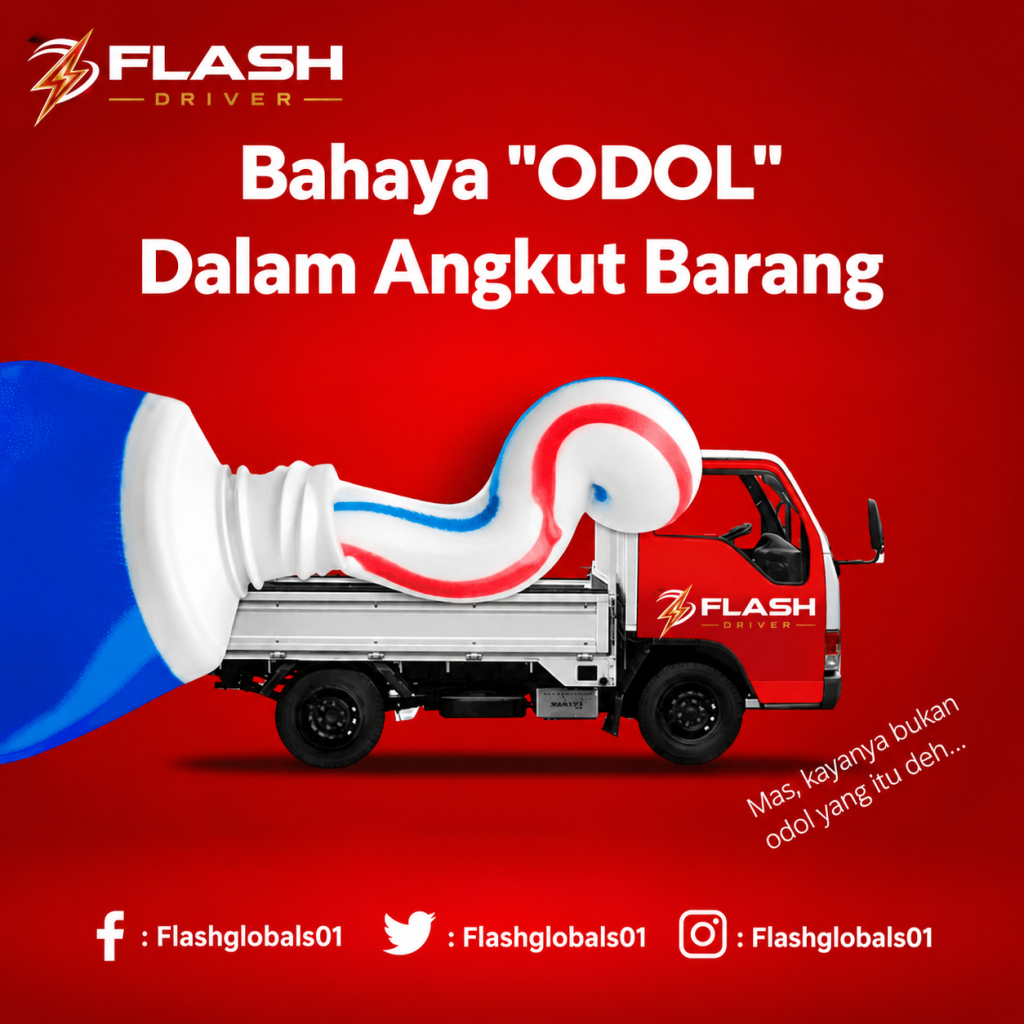
The Risks of Overloading on Trucks (ODOL)
Indonesia's development has gone hand in hand with growing public demand for transport services. As a result, business in Indonesia has also grown, driven by the emergence of businesses such as Goods Transport Services or transport services that act as a means of mobility, such as Pickup Rental and Truck Rental.
Goods transport businesses offer many types of vehicles, from those carrying small and medium loads to those carrying large loads.
Today there are many goods transport companies offering Goods Transport Services for large, bulky and heavy loads, such as cargo shipping services.
These large, bulky and heavy loads are sometimes abused by unscrupulous operators. We often come across trucks carrying loads beyond their capacity, a practice known as Over Dimension Overload (ODOL).
Over Dimension Overload is a condition in which a truck and the goods it carries exceed the truck's maximum capacity in terms of weight or dimensions.
There are two types of ODOL trucks. The first is overloading that occurs because the load is heavier than the vehicle's carrying capacity.
The second is overloading that occurs because the vehicle owner deliberately modifies the vehicle beyond the maximum permitted dimensions, or loads goods so excessively that they exceed the truck's dimensions.
Based on these types, ODOL trucks can usually be recognised by cargo that exceeds the truck's dimensions, such as being wider or taller than the truck itself. ODOL trucks also struggle to climb inclines because the load is heavier than the truck can handle.
The ODOL truck phenomenon clearly poses risks to service users and service providers alike, as well as to the wider public who are affected by it.
There are countless news reports of traffic accidents caused by ODOL trucks. Roads are also damaged by overloaded ODOL trucks, which in turn leads to accidents and even loss of life.
Although the government has tried to eliminate ODOL trucks, some operators still refuse to follow the rules.
The ODOL truck phenomenon is common partly because service providers want to offer the lowest possible price with minimal operating costs.
There are also careless truck drivers who want to make their job easier by loading cargo without paying attention to the truck's maximum volume limit.
Business competition is another driver of this phenomenon, as the goods transport business is booming in Indonesia, from sole traders to large companies. These service providers compete to offer customers the lowest price for the biggest loads and the greatest carrying capacity.
This can lead to losses, including:
1. Engine damage that affects the truck's power.
Truck engine power is regulated by Government Regulation No. 55 of 2012, which requires vehicles such as tronton (triple-axle) trucks to have a minimum of 4.5 kilowatts per 1,000 kg, while combination vehicles such as trailer trucks require 5.5 kilowatts per 1,000 kg. If a truck is loaded beyond this, it risks engine damage from ODOL practices.
2. Brake failure due to overloading
Brakes are absolutely critical. When braking, the brakes are no longer strong enough to resist the excessive forward force caused by the extra weight. The result is Brake Fading, a loss of braking power commonly known as brake failure (rem blong), especially when the vehicle is travelling downhill
3. Tyre damage from excessively heavy loads
Exceeding the tyres' capacity puts them under greater pressure than they are designed for, creating friction beyond their limits that causes them to overheat, which can make them burst. Besides tyre damage, excess weight can also damage the truck's axles and suspension, for example causing a broken axle or broken suspension.
4. The Vehicle Becomes Unstable
Overloading can also affect a vehicle's stability. Drivers can lose control because the load is too heavy or exceeds the proper dimensions. Trucks are designed based on calculations of strength and dimensions to keep them stable; by running a truck as an ODOL vehicle, it risks becoming unstable and may even clip other vehicles, for example when turning.
5. Higher Fuel Consumption
With so much cargo on board, the engine naturally has to work harder than usual, which leads to higher fuel consumption.
6. Blind Spots
Modifying a truck to the point of being over-dimension means its dimensions are no longer standard, which risks reducing visibility and increasing blind spots. This endangers both the truck itself and other vehicles, especially when manoeuvring.
7. Risk of the vehicle tipping over on inclines
A truck operating as an ODOL vehicle clearly violates the truck's carefully calculated design. The truck can tip over due to excess weight, especially when turning or manoeuvring (centrifugal force) or climbing, because the load at the rear is much heavier than at the front.
The bottom line:
In general, the ODOL truck phenomenon is a cause of traffic accidents and can also damage public facilities such as roads.
That is why ODOL trucks need to be dealt with seriously by the government, as their impact is extremely damaging to the country.
The government urges goods transport providers to always comply with government regulations on ODOL. The government also hopes that service providers can play a positive role in driving Indonesia's economy.
To this end, the Ministry of Transportation created the Zero ODOL 2023 scheme. Achieving this plan requires cooperation between business owners, the police and the government.
One of the government regulations governing ODOL trucks is Article 277 of Law No. 22 of 2009 on Road Traffic and Transportation (LLAJ), which states:
“Any person who brings motor vehicles, trailers and semi-trailers into the territory of the Republic of Indonesia, or who manufactures, assembles or modifies them in a way that changes their type, including trailers, semi-trailers and special vehicles operated domestically, that do not meet type-testing requirements, shall be punished with imprisonment of up to 1 year or a fine of up to Rp24,000,000.”
With these regulations and firm government action, it is hoped that the ODOL phenomenon will no longer occur. Service providers should comply with government regulations, because the losses are not borne by the government alone; they can also harm and endanger the providers themselves. As business owners, we naturally want to avoid anything that could harm our business.
TheLorry, a goods transport service provider, offers truck rental, and of course the drivers who partner with TheLorry have been trained never to exceed the truck's capacity when transporting goods, unlike ODOL trucks.
Sources:
https://balitbanghub.dephub.go.id/berita/kajian-pengendalian-over-dimensi-over-loading
https://dishub.kukarkab.go.id/detailpost/larangan-overdimensi-dan-overload-pada-kendaraan-bermotor
Author: Justin Satria Wibawa Nurzaman
Last updated: 23 October 2026
For more information: