What Are FTL & LTL?
Want to rent a truck but don't know what FTL and LTL mean?
Still unsure which truck rental service is right for you?
Relax, Flash Globals will explain FTL and LTL in truck rental services
Truck Rental
Basically, renting a truck is the best solution for shipping large, heavy or high-volume goods.
From large or heavy parcels and bulk shipments to house moves, office relocations, construction projects and even heavy equipment transport.
When you rent a truck, there are 2 main service types: FTL and LTL.
But did you know that there are also PTL and EUV options?
Want to know more?
Read the full explanation here
FTL (Full Truck Load)
Full Truck Load (FTL) is a service for shipping large volumes of goods in which one entire truck is used for a single shipment, so your goods are never mixed with other shipments.
FTL is usually chosen based on the goods or cargo being loaded: the goods from a single shipper fill the truck's capacity.
This means the truck's cargo bed or box is completely filled with goods from one shipper.
This service is intended for companies with high shipping volumes, or for individuals who need to ship large quantities of goods.
Sometimes a shipper may also want exclusivity, in which case the truck still departs even if it is not completely full. This is covered in the EUV section
The advantages of FTL are security and speed.
FTL is faster and safer because there is no repeated loading and unloading or shifting of cargo inside the truck's cargo bed or box.
In addition, since there is only one shipper, the truck can go straight to the destination, which also makes delivery faster.
However, FTL does have a drawback: cost.
FTL services tend to be more expensive than LTL because the cost is borne by a single shipper.
That said, the cost is offset by the lower risk of errors and damage.
LTL (Less Than Truck Load)
Less Than Truck Load, usually abbreviated as LTL, is a truck rental service in which the truck's capacity is shared among several shippers.
The truck is still filled to capacity, but with a mix of goods from several different shippers.
For example, a single-axle (engkel) truck or CDE truck has a carrying capacity of 2 tons, so those 2 tons can be filled with goods from several shippers.
Cargo from different shippers is consolidated into one truck, allowing the shipping cost to be split among several shippers.
Naturally, each shipper's share of the cost is determined by the weight or volume their goods take up in the truck, so the heavier or larger the goods, the higher the charge.
This is very cost-effective for individuals or businesses that don't have enough goods to fill an entire truck.
That is why LTL is very popular with shipping companies, as it can accommodate many types of goods and shipping volumes to suit different needs.
In terms of weight and volume, LTL services for single-axle (engkel) or CDE trucks generally accept goods weighing less than 2,000 kg, or less than 6 pallets or 6 CBM in volume.
The main advantage of LTL truck rental is, of course, cost: the lighter and smaller your goods, the cheaper the charge.
The drawback, however, is that since the truck carries goods from several shippers, delivery takes a little longer than a Full Truckload (FTL) shipment
The truck has to stop at several locations along a set route.
There is also a trade-off in terms of security.
In some cases, goods in the truck's cargo bed or box are loaded and unloaded several times, which can cause jolts and shifting of goods inside the cargo bed or box.
FTL VS LTL
Now that you know what FTL and LTL are, here is a table of factors to consider for each service
| Aspect | FTL (Full Truckload) | LTL (Less Than Truckload) |
|---|---|---|
| Risk | Low | High |
| Speed | Fast | Slower |
| Route | On request | Fixed route |
| Cost | Higher | Lower |
| Loading & Unloading | Loaded and unloaded once | Loaded and unloaded several times |
| Flexibility | High | Low (scheduled) |
| Security | Safer | Less safe |
| Monitoring | Easier | Complex |
| Booking Time | Flexible | Scheduled |
| Errors | Low | Higher |
Partial Truck Load (PTL)
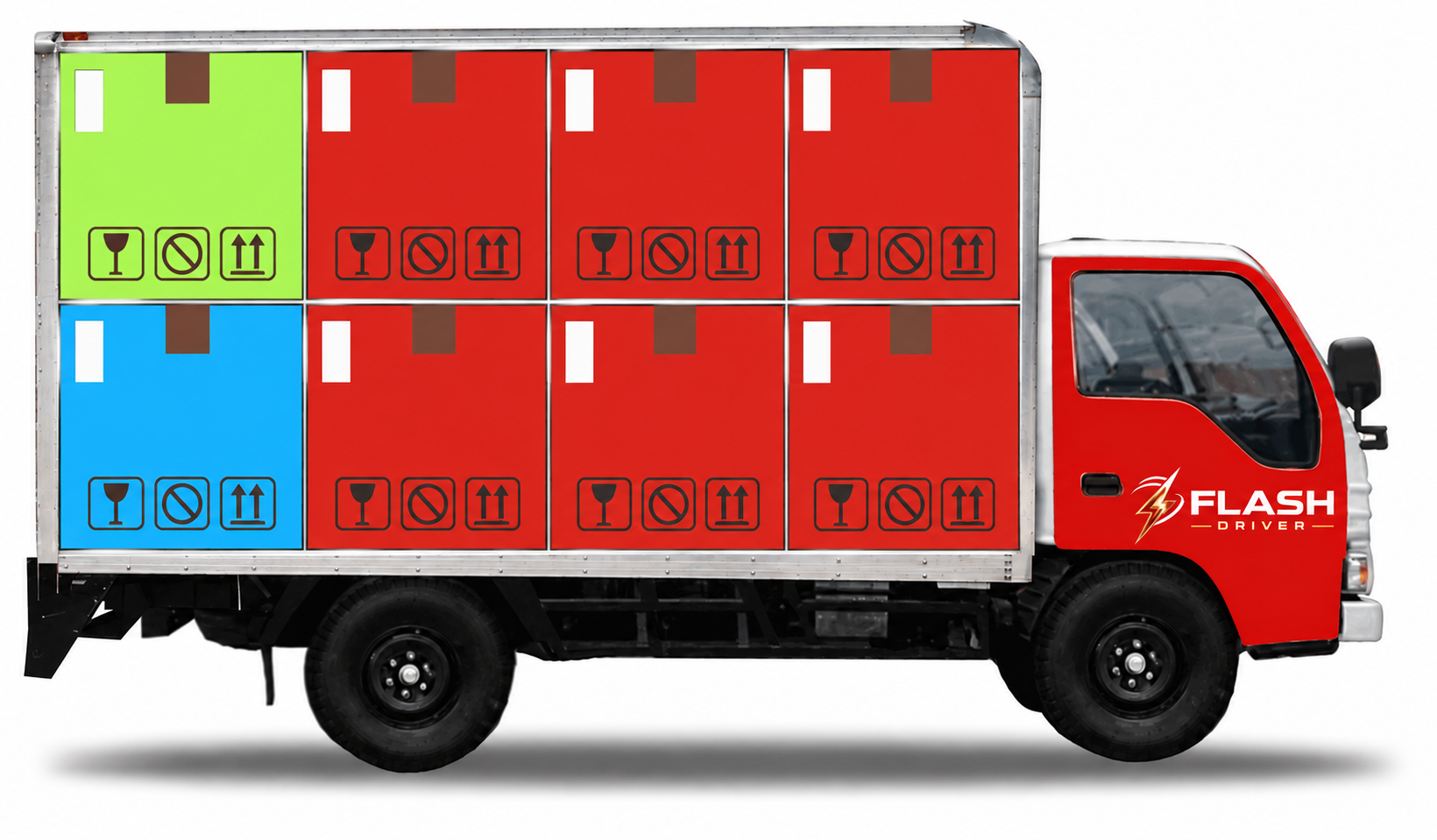
Besides FTL and LTL, did you know there is another truck rental method? It's called PTL.
Partial Truck Load, or PTL, is a truck rental service that sits between FTL and LTL.
This is because it involves shipping a large quantity of goods that fills most of the truck's capacity, without renting the truck's full capacity.
Some logistics operators describe PTL as "volume LTL" because, although the shipper does not rent the truck's full capacity, the goods take up almost all of it, leaving only a little space for other renters or shippers.
The goods carried are usually large but not very heavy, so they are not charged by actual weight but by volumetric weight, since their size almost fills the truck's capacity.
As an informal calculation, some references describe PTL truck rental as applying to goods weighing more than 2,250-11,300 kg, or equivalent in volume to 6-18 pallets or 6-18 CBM.
EUV or Exclusive Use Vehicle
Besides FTL, LTL and PTL, there is one more special truck rental method: EUV.
Exclusive Use Vehicle
Exclusive Use Vehicle, or EUV, is a truck rental service in which you rent the entire truck regardless of how much cargo you carry (while still staying within the truck's maximum capacity and not overloaded or over-dimensioned, i.e. ODOL).
An EUV, or Exclusive Use Vehicle, service is the right choice if you need to rent trucks in large numbers or transport special goods.
The truck is rented to a single shipper only, and in some cases it can be rented without a driver (lepas kunci), rented for a full day, or slightly modified to suit the shipper's needs.
The truck can also be rented for a set period of time, so the shipper is free to make deliveries according to their preferred schedule and route.
From the shipper's point of view, EUV is the safest service, because everything is arranged according to the shipper's wishes.
Of course, it also costs more than FTL, LTL or PTL services.
Conclusion
Choose the service that suits your needs
Use an FTL service when your goods are large, heavy or numerous enough to fill the truck's capacity
Use an LTL service when your goods are not that large, heavy or numerous, so they can share truck space with other shippers
Use a PTL service when your goods fill almost all of the truck's capacity, leaving only a little space for other shippers.
And use an EUV service when you need to rent a whole truck, whether or not it will be fully loaded, to use as you need.
Author: Justin Satria Wibawa Nurzaman
Editor: Bani Darmawan
Last updated: 7 October 2026
References
What is partial truckload shipping? – https://www.freightquote.com/define/what-is-partial-truckload-shipping/
What Is Partial Truckload Shipping and Why Use It? – https://cowtownexpress.com/blog/what-is-partial-truckload-shipping-and-why-use-it
LTL, FTL, PTL or EUV – What’s the Difference? – https://shippei.com/ltl-ftl-ptl-or-euv-what-do-they-all-mean/
FTL dan LTL: Kenali Opsi Pengiriman Anda (FTL and LTL: Know Your Shipping Options) – https://www.deliveree.com/id/ekspedisi/ftl-ltl-kenali-opsi-pengiriman-anda/
Apa Itu LTL dan FTL dalam Pengiriman? Cari Tahu dari Layanan Kargo (What Are LTL and FTL in Shipping? Find Out from a Cargo Service) – https://kargo.tech/en/blog/perbedaan-pengiriman-ftl-dan-ltl/
Perbedaan Pengiriman FTL dan LTL dalam Distribusi Barang (The Difference Between FTL and LTL Shipping in Goods Distribution) – https://www.abcexpress.id/blog/pengiriman-ltl-ftl
Apa Itu LTL & FTL Serta Kelebihan dan Kekurangannya? (What Are LTL & FTL and Their Pros and Cons?) – https://www.knic.co.id/id/apa-itu-ltl-ftl-serta-kelebihan-dan-kekurangannya
FTL dan LTL: Pengertian, Kelebihan, dan Kekurangannya (FTL and LTL: Definition, Advantages and Disadvantages) – https://mile.app/id/blog/ftl-dan-ltl
Author: Justin Satria Wibawa Nurzaman
Last updated: 23 October 2026